Introduction
Overload a
truck bed cover and the panels bow or crack, the mounting clamps bend or tear loose from the bed rails, and the seal and tension system stop doing their job, which usually means it no longer latches right or keeps water out. On a roll-up or folding cover you can also damage the tension mechanism itself, and once that is gone the cover will not sit flat again.
The part that catches people out is not the number. It is what the number means. Almost every bed cover weight rating you will find describes distributed weight, spread evenly across the surface. It does not describe setting a toolbox or a bag of concrete in the middle of the panel, and that distinction is responsible for most of the broken covers we see.
So here is what actually fails, in what order, and what to do if you genuinely need to carry weight up there.
What Happens When You Exceed a Truck Bed Cover Weight Rating
Failures go in a fairly predictable sequence:
- Panel deflection. The surface flexes more than it should under the load. At this stage nothing is broken and you may not notice.
- Permanent bowing. The panel stops returning to flat. Now water pools in the low spot, which adds weight, which deepens the bow.
- Creasing. On folding and roll-up covers, a crease across the panel is a permanent hinge point. It will keep folding there.
- Cracking or splitting, usually starting at a stress point or an edge.
- Clamp and rail damage. The clamps that hold the cover to the bed rails bend, strip or pull. This is the failure that matters most, because it is the one that can come apart on the highway later.
- Seal failure. Once the geometry is off, the weather seal no longer contacts the bed rail evenly, and you get water in the bed.
- Latch and lock misalignment. The cover will not close or lock properly because nothing lines up anymore.
- Tension system damage on retractable and roll-up covers, where the spring or tensioner is no longer holding the material taut.
- Bed rail damage to the truck itself, which is the expensive version of this problem.
The order matters because the early stages are silent. By the time you notice the cover is not sealing, the damage happened a while back.
Distributed Load vs Point Load: The Part Everyone Misses
This is the single most useful thing to understand about bed cover ratings, and it is why a cover can fail at well under its stated number.
A distributed load is weight spread across the whole surface. Snow is a distributed load. So is a tarp full of leaves, or a thin even layer of anything. That is the condition almost every published rating describes.
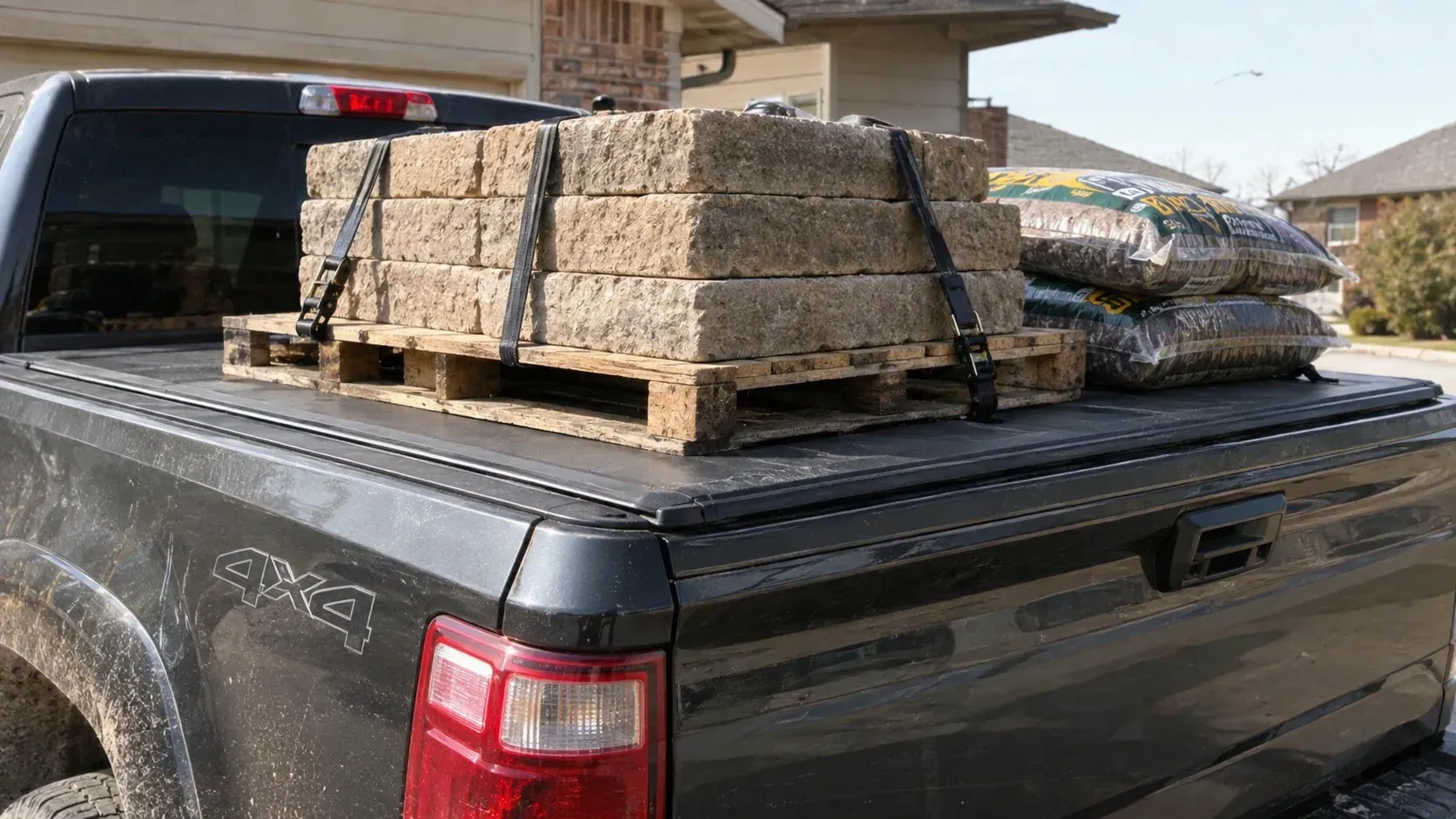
A point load is weight concentrated in one spot. A toolbox. A cooler. A bag of feed. A knee. The cover's rating does not apply to that, because the panel is now being asked to carry the same weight through a fraction of the area, and panels fail by bending rather than by weight.
Which is why a cover rated for a few hundred pounds of snow can be damaged by a single item that weighs a small fraction of that. The load did not exceed the rating. It exceeded what the panel can carry in one place.
Two things follow. Never assume a rating gives you permission to set something heavy on top. And if you must put something on a cover, spread the load across as much surface and as many supports as you can, and keep it off the middle of unsupported spans.
Tonneau Cover Weight Limits by Cover Type
Different constructions fail differently. We are not going to publish numbers for any of them, because ratings vary enormously by manufacturer and model and the only number that matters is the one for the cover you actually own. But the failure behaviour is consistent:
- Soft roll-up covers. The lowest tolerance of the group. The material is supported by crossbars with unsupported span between them, so weight between bars goes straight into the fabric and the tension system. Snow load is the common failure.
- Soft folding covers. Similar limits, with the added weak point of the hinges between panels.
- Hard folding covers. More rigid and generally more tolerant of distributed weight, but the hinge seams remain the weak line and a crease there is permanent.
- Retractable covers. The canister and track system add complexity. Weight can bind the slats in the tracks, and damage to the tensioner is not a cheap fix.
- One-piece hinged hard covers. Usually the most rigid, and the closest thing to a surface you can treat as semi-structural. Still not a rack.
- Bed covers with integrated rack systems. The only category actually designed for weight on top, because the load goes into the rack and the bed rails rather than into the cover panel.
Notice that the strongest options in that list are strong because the load path bypasses the panel. That is the whole principle.
Snow, Water and the Loads You Did Not Put There
Out here you get both, and neither one asks permission.
Snow accumulates evenly, which is the load type covers handle best, but it accumulates a lot. Wet snow is heavier than dry snow by a wide margin, and a cover that shrugged off a foot of powder can be in trouble under a few inches of heavy wet snow. Then it partially melts, refreezes, and you have ice, which is heavier still and which does not brush off.
Standing water is worse in a specific way: it is self-worsening. A slight low spot collects water, the water's weight deepens the low spot, which collects more water. A cover that has developed a permanent bow will do this every rain until it fails.
What helps:
- Clear snow off rather than letting it accumulate and refreeze, especially wet snow
- Use a soft brush, not a shovel or a scraper, and never chip at ice on a cover panel
- Check for standing water after rain, since a puddle that has not drained is telling you the panel has already deflected
- Watch the tension on roll-up and retractable covers through winter, since cold stiffens materials and tensioners
- Keep the seals clean so water drains where it is supposed to instead of pooling
The other load nobody counts is a person. Standing on a bed cover to reach the cab roof or a rack is a point load of well over a hundred pounds through the size of a boot sole. It is one of the most common ways covers get creased.
Overloading Bed Cover Damage and What It Costs You
The reason to care is not the cover. It is everything downstream of it.
- The cover itself. Panels and clamps are often replaceable individually, but a creased or cracked panel is not repairable and a damaged tensioner can approach the cost of the cover.
- Your warranty. Manufacturer warranties generally exclude damage from exceeding the load rating or from improper use. Overload damage is usually on you.
- Your cargo. A cover that no longer seals lets water into the bed, and a cover that no longer latches is not securing anything.
- Your truck. Damaged bed rails, stripped clamp points and scratched paint at the rail line are body work, not accessory replacement.
- Theft protection you thought you had. A cover that does not lock properly is a cover that does not lock.
- Everybody else on the road. A clamp that lets go at speed puts a panel into traffic. This is the failure mode that turns a parts problem into a liability problem.
That last one is worth sitting with. Unsecured cargo and detached equipment are a real hazard, and a cover you overloaded last month is not necessarily going to fail while it is loaded. It can fail empty, later, at seventy.
Where to Find Your Bed Cover Cargo Rating
Go to the source rather than a forum. In rough order of reliability:
- The manufacturer's installation manual or owner documentation for your exact model. This is the authoritative answer and it usually states whether the number is distributed or not.
- The manufacturer's product page or spec sheet for your specific model and year.
- The manufacturer directly. Call or email them with the model number. They will tell you, and they will tell you what the rating covers.
- The label or sticker on the cover or inside the canister, if there is one.
- Us, if you bought it here or you want a second opinion on what your setup can carry.
What not to rely on: a number somebody quoted for a different brand, a general figure for "tonneau covers," or an assumption based on how solid the panel feels. And if the documentation gives a number without saying whether it is distributed, treat it as distributed, because it almost always is.
What to Use Instead When You Actually Need to Carry Weight Up There
If your real problem is that you need to haul something on top of the bed, a cover is the wrong tool and no amount of care fixes that. The right answers:
- A bed rack or headache rack, which carries load into the bed rails and frame rather than into a panel. This is the correct solution for lumber, ladders, kayaks, rooftop tents and anything else with real weight.
- Crossbars designed for your cover, where the manufacturer offers them, which give you a rated load path that does not go through the panel.
- A cover-and-rack combination system, purpose-built for both jobs.
- A bed slide or drawer system, if the goal is organizing heavy gear inside the bed rather than on top of it.
- Load bars inside the bed, for securing cargo below the cover line.
Our accessory work runs from trailer hitches and bed covers to bumper replacements and floor mats, and the useful conversation is usually not which cover is toughest. It is what you are actually hauling, how often, and whether the load belongs on top of the bed or in it. Those answers point to different products.
The Payload Question Underneath All of This
One more thing, because it gets missed when people focus on the cover.
The cover's rating is a separate question from your truck's payload. A cover can be perfectly happy while the truck is overloaded, and vice versa. Payload is the total weight your truck is rated to carry including passengers, cargo, accessories and tongue weight, and adding accessories reduces what is left for cargo.
If you are regularly loading the bed heavily enough to be thinking about what the cover can take, it is worth checking the door jamb sticker for your actual payload figure and doing the arithmetic. Heavy loads also change how the truck sits and handles, which is a suspension conversation rather than an accessory one, and our look at choosing suspension for hauling and towing covers the sagging and sway side of it.
Conclusion
A bed cover is weather protection and security. It is not a deck, and its rating almost certainly describes weight spread across the whole surface rather than something set down in the middle.
Find the real number for your specific cover from the people who made it, assume it is a distributed figure unless they say otherwise, keep snow and standing water off it, and stop standing on it. If you need to carry weight above the bed, buy the thing designed to do that instead of asking the cover to.
Find a Bed Cover Rated for What You Actually Haul
Tell us what you are hauling and how often, and we will tell you which cover suits it, or whether what you really need is a rack. That conversation takes a few minutes and it saves buying the wrong thing twice.
FatDaddy Performance installs premium bed covers built to keep cargo safe and secure in any weather, along with B&W trailer hitches, bumper replacements and the rest of the accessory side. Installation is done in house by our own technicians, and if you bought the cover elsewhere we can still look at what it is rated for.
We are at 7910 West McCormick Road in Amarillo and work across the Panhandle, roughly a 50-mile radius. Call
(806) 513-2020 or email
sales@fatdaddyperformance.com. More on how we handle accessory projects is in our FAQs.