Introduction
A
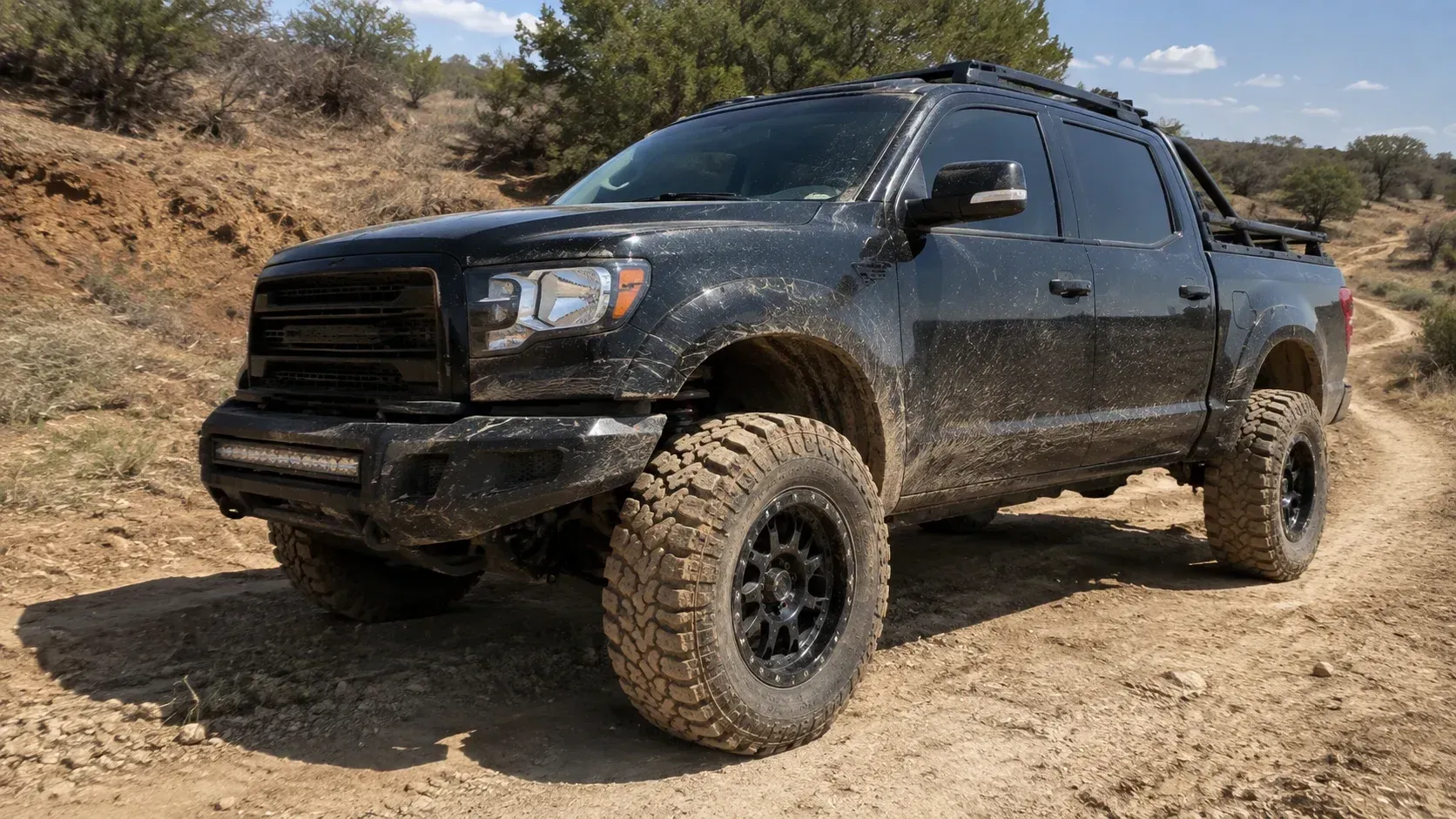
lifted truck that pulls to one side out on the county roads is usually reacting to two things at once: the crown of the road, and an alignment that was never reset after the lift went on. Add uneven tire pressure or a worn track bar and it gets worse in a hurry. The road crown part is normal and affects every vehicle. The alignment part is the one that is actually costing you tires.
That distinction matters, because a lot of guys chase the wrong thing. They adjust their grip, put up with it, and replace a set of tires eighteen months early. Meanwhile the fix was a single trip to have the angles set for the height the truck actually sits at now.
Here is how to tell which one you are dealing with.
Why a Lifted Truck Pulls to One Side More Than a Stock One
A stock truck is riding on the geometry the factory engineered for that ride height. Change the height and you change the geometry, because the control arms, steering links and axle now sit at angles they were not designed around.
What a lift does to how the truck tracks:
- Alignment angles move. Caster in particular, which is the angle that gives a truck its tendency to return to straight and hold a line. Lose caster and the truck stops self-centering and starts following whatever the road tells it to do.
- The steering linkage angle changes, which affects how much the steering fights road inputs.
- Track bar geometry changes on solid front axle trucks, which can shift the axle slightly off center.
- Taller tires amplify everything. A bigger tire has a larger contact patch and more sidewall, so it transmits road slope and pulls harder than a smaller tire would.
- Wheel offset changes the scrub radius. Push the wheels out with aggressive offset and the steering picks up more feedback from bumps and grooves.
- More unsprung weight on a heavier wheel and tire package makes the front end lazier to recover.
None of that means a lift is a mistake. It means a lift is not finished when the bolts are torqued. The geometry has to be set afterward, and our own breakdown of what a leveling kit installation actually costs makes the same point in blunter terms: skipping the alignment is how a modest job turns into a tire bill.
What Crowned Rural Roads Do to a Truck Pull
Here is the part nobody tells you when you buy a lifted truck.
Roads are built with a crown, meaning the center sits slightly higher than the edges so water runs off instead of standing on the surface. On a wide, well-maintained highway that slope is gentle and you barely notice it. On a narrow two-lane county road it is far more pronounced, because the same drop has to happen across half the width.
Drive in the right lane of a crowned road and your truck is sitting on a slight downhill slope toward the shoulder. Gravity does what gravity does. The truck drifts right. Every vehicle does this. Yours does it more because you are taller, on bigger tires, with more sidewall to flex.
That is why the same truck that tracks straight on the interstate wanders toward the ditch on a farm road. The truck did not change. The road did.
The test is simple enough. Find a genuinely flat stretch, an empty parking lot or a wide road where you can safely sit in the middle for a moment, and see whether the pull is still there. If it goes away, you were feeling crown. If it does not, keep reading.
Truck Pulling After a Lift Kit: The Alignment Angles That Change
Three angles do the work, and a lift moves all of them:
- Caster. The forward or rearward tilt of the steering axis. This is the big one for straight-line stability and self-centering. Lift a truck and caster typically gets reduced, and uneven caster side to side is a classic cause of a steady pull toward the side with less of it.
- Camber. How far the top of the tire tilts in or out. A lift usually pulls camber in a positive direction, and a side-to-side difference makes the truck drift toward the more positive side. Camber also chews the edges off tires.
- Toe. Whether the front tires point slightly toward or away from each other. Toe does not usually cause a pull on its own, but it is the fastest way to destroy a set of tires, and it changes with ride height.
Two practical notes. Some kits include correction hardware for exactly this reason, and some do not. And on newer trucks, changing ride height can affect electronic steering assist and driver-assist systems that reference the steering angle, which is why recalibration sometimes belongs in the conversation alongside the mechanical alignment.
The takeaway is that alignment after a lift is not a tune-up item. It is part of finishing the install.
Pull, Wander or Drift: Telling Them Apart
These get used interchangeably and they point at different problems. Pay attention to what your truck is actually doing.
Crown drift. Follows the road. Consistent direction based on which lane you are in. Goes away on flat ground. The truck still feels solid and centered. Normal.
A steady pull. Same direction regardless of the road or the lane. The steering wheel has to be held off center to go straight. That is alignment, a tire, or a brake.
Wander. The truck does not pull one way, it just will not settle. You are making constant small corrections. That points at loose or worn components, low caster, or a track bar problem rather than alignment settings.
A pull under braking only. Dead straight until you touch the brakes, then it darts. That is a brake problem, usually a sticking caliper or a collapsed hose, and it has nothing to do with your lift.
A pull that appeared overnight. Something broke or came loose. Treat that differently from a pull that has been there since the lift went on.
Knowing which one you have saves you money, because the four causes are not fixed the same way.
The Other Usual Suspects
Beyond crown and alignment, the list we work through:
- Uneven tire pressure, front to side. This is the single most common cause and the easiest to rule out. Check them cold.
- Tire conicity or belt shift. A tire can pull all by itself from a manufacturing variance or internal damage, and it looks completely normal from the outside.
- Mismatched tires across the front axle, whether in brand, wear or tread pattern.
- Uneven tire wear that developed from a bad alignment and now causes its own pull, so the problem persists after the alignment is fixed.
- A worn or loose track bar on solid axle trucks. This is a common wander and pull source on lifted trucks and it gets overlooked constantly.
- Worn ball joints, tie rod ends, drag link or control arm bushings. A lift puts these components at new angles and they can wear faster than stock.
- A bad wheel bearing.
- Sticking brake caliper, which causes drag on one side all the time, not just under braking.
- Bent components from a hard hit, a curb strike or a washout in a bar ditch.
- A loose or worn steering box or damper.
The reason we put alignment first is not that the other items are rare. It is that on a lifted truck, alignment is the one thing we can almost guarantee is off if nobody set it after the lift.
What You Can Check in Your Own Driveway
Free, takes twenty minutes, and it narrows the problem down considerably:
- Check all four tire pressures cold, before driving, against the door jamb sticker or whatever spec your tire setup calls for. Correct them and drive it again.
- Look at your tire wear. Feathering, one edge worn, or a scalloped pattern each point somewhere different.
- Note where the steering wheel sits when the truck is going straight. If the spokes are cocked off center, that is an alignment finding on its own.
- Drive it on flat ground and see whether the pull survives.
- Swap the front tires side to side. If the pull changes direction, it is a tire. If it stays put, it is not. This one test eliminates an entire category.
- Grab the steering wheel at a stop and check for play before the wheels move.
- Listen at low speed over rough ground for clunking, which usually means a worn joint or a loose track bar.
- Look underneath for anything obviously torn, loose, leaking or wet.
Write down what you find. Walking in with that list makes the diagnosis faster and cheaper than walking in and saying it pulls.
Why Panhandle Farm-to-Market Roads Make It Obvious
Our roads are a good test environment for this whether you want one or not.
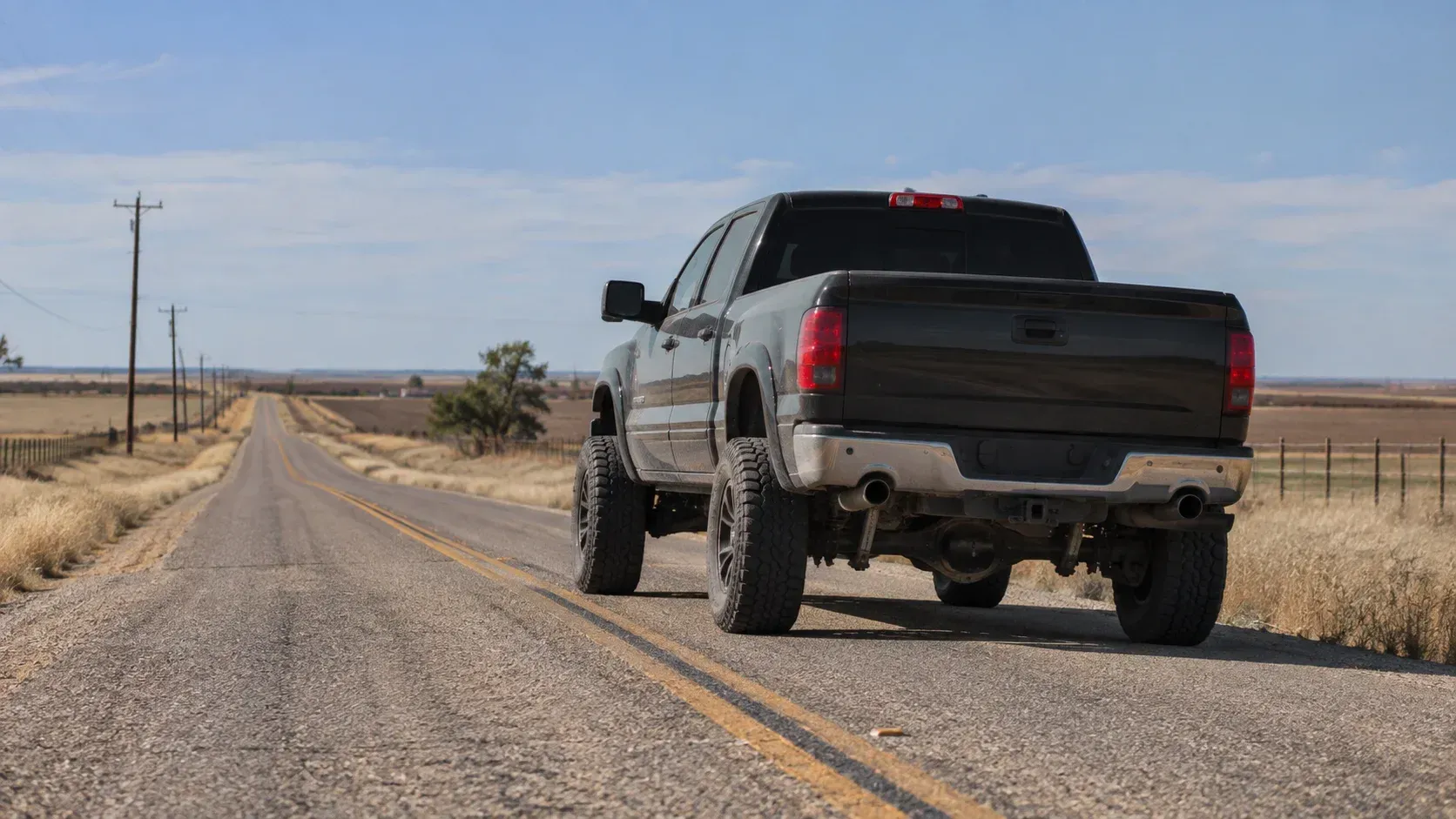
Farm-to-market and county roads out here are narrower than highways, so the crown is steeper across the lane. Plenty of them have soft or dropped shoulders, which punishes drift toward the edge. Many have been patched, resurfaced and rutted over decades, so the surface is not one consistent plane. Add the wind, which is real and which pushes a tall truck around all on its own, and a truck that is only slightly out of alignment feels considerably worse than it would somewhere flat and sheltered.
There is also a wear angle. Washboard gravel, cattle guards, bar ditches and unpaved section roads are harder on suspension and steering components than pavement is. Parts that would last a long time on a commuter truck wear faster out here, which means a lifted truck that sees real dirt needs its joints and bushings looked at more often, not less.
If you spend your driving time between Amarillo and Canyon on the section roads, your truck is getting a harder test than the guy who drives I-40. That is worth knowing before you decide the pull is normal. Our work with drivers around Canyon runs heavily toward trucks that live on exactly those roads.
When You Should Stop Driving On It
Most pulls are an annoyance and a tire expense. A few are not. Stop and get it looked at if:
- The pull showed up suddenly rather than gradually
- You hear clunking, popping or grinding along with it
- There is noticeable play in the steering wheel before the wheels respond
- The truck darts under braking
- The steering feels loose, vague or like it is disconnected from something
- You can see a torn boot, a leaking shock, or a component that is visibly loose
- The truck wanders badly enough that you are working to keep it in the lane
- A tire is showing cords, chunking, or wear on the inside edge you did not notice before
Steering and suspension components do not usually fail gradually once they are past a certain point. That is not a scare tactic, it is just how joints work.
Conclusion
Sort the crown out from the alignment first. Drive it on flat ground, check your pressures cold, and swap the front tires side to side. Those three steps take twenty minutes and tell you most of what you need to know.
If the pull survives all three, the truck is telling you its geometry does not match its ride height, which is the normal state of a lifted truck that never got its angles set afterward. That is a fixable problem, and it is cheaper to fix than the set of tires you will otherwise scrub off.
Get Your Lift and Suspension Checked
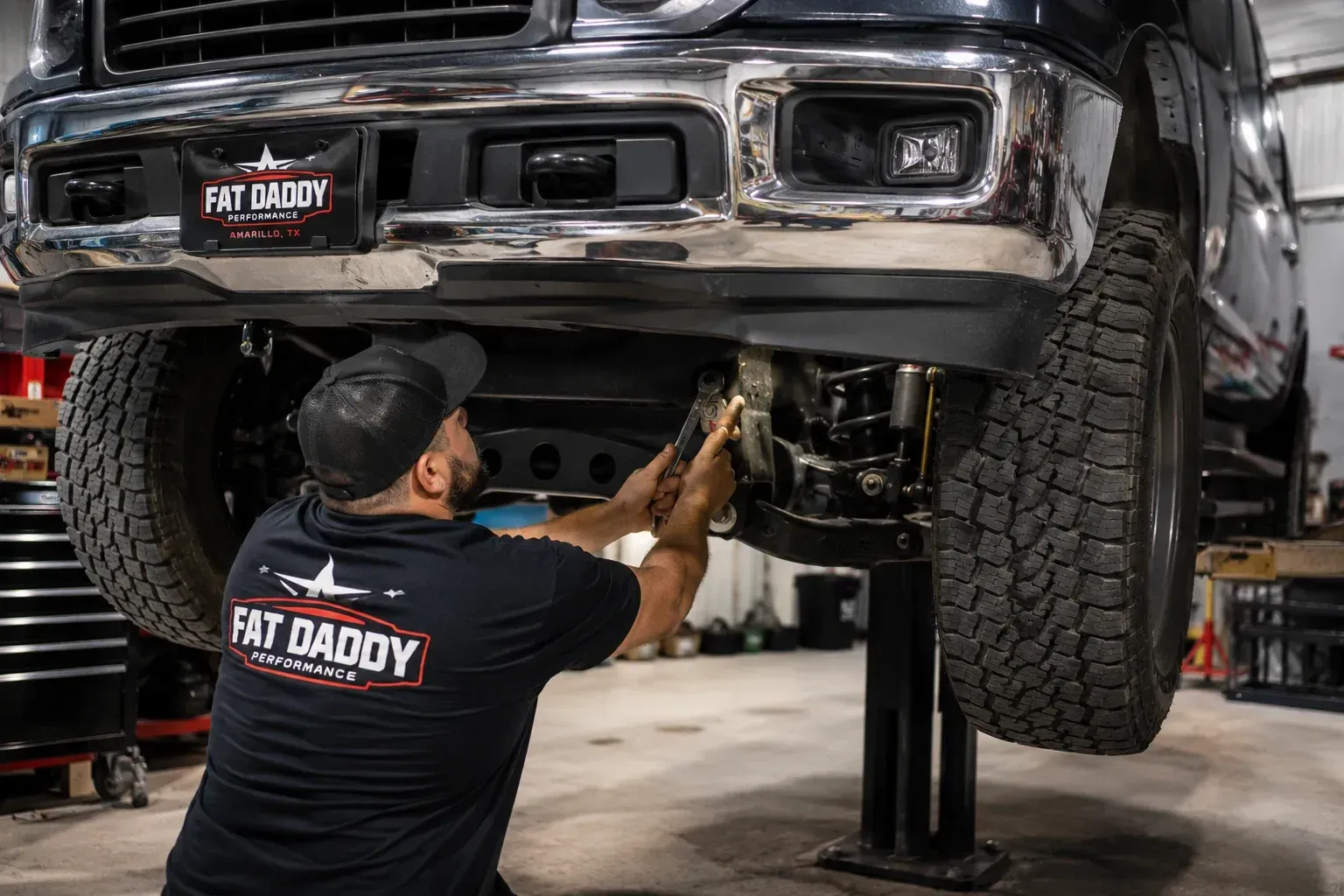
If your truck pulls, wanders or has never felt right since the lift went on, bring it by and we will go through the suspension and steering and tell you what we find. Sometimes the answer is that the geometry needs setting. Sometimes it is a track bar. Sometimes it is a tire and you are out almost nothing.
FatDaddy Performance is at 7910 West McCormick Road in Amarillo, and we work on trucks across the Panhandle, roughly a 50-mile radius, including Canyon, Bushland, Hereford, Borger and Pampa. Our suspension work covers upgrades, shock and strut replacement and lift installs, and if the problem traces back to the kit itself, our leveling kit and lift side is where that gets sorted.
Call
(806) 513-2020 to get it on the schedule.